As export-driven companies grow, production is often distributed across multiple locations. A machine or component may be manufactured in Denmark, while additional production is established in countries such as Poland or India to optimize logistics and costs. Although the overall product is the same, this geographic distribution creates an enormous data challenge that is often underestimated.
A product manufactured in Poland may have different certifications, use different components, or have significantly different delivery times than the same product manufactured by the parent company.
These differences are vital.
If a product is sold to a customer with strict requirements regarding origin or certification, an error in the product data can lead to canceled orders or legal consequences.
When product data needs to speak multiple languages
When export numbers account for most of the revenue, information must be available in the appropriate languages for each market. Technical documentation, user manuals, and product descriptions cannot simply be translated on an ad hoc basis. As noted earlier, they must also remain synchronized and up to date.
When product data is structured and maintained in a central system, it also becomes easier to use AI for purposes such as translation and localization. An AI platform like Interakt, for instance, can make information searchable in multiple languages even when the underlying product data is maintained in only one place and in a limited number of languages.
Capabilities like these make it easy for an agent or customer to find the relevant spare part in their preferred language.
But remember, AI is not a replacement for the underlying data foundation: translations are only reliable when they are based on accurate, up-to-date product data.
This creates a need for a single system that brings together established workflows, detailed files, and complex documents, structures them, and makes them available across sales channels.
PIM as the solution to data chaos
To manage this complexity, product data can no longer remain isolated across spreadsheets, documents, and local systems.
Product data must be structured and consolidated so the company can maintain the information in one place and distribute it to the relevant markets and channels.
A PIM (Product Information Management) system acts as the central hub for all product attributes, including country of origin, certifications, dimensions, weight, and variants.
When the PIM system is integrated with other systems and channels, an approved change can be distributed automatically to the relevant markets.
PIM systems are designed to handle continuous changes to product data and make it significantly easier to maintain information for thousands of products. This reduces manual coordination and lowers the risk of different markets working with different versions of the same product information.
Integration as a prerequisite for scaling
A strong digital foundation requires close integration between ERP and PIM. The ERP system typically manages production and logistics data (where was the product made?), while the PIM system manages how the product should be presented (which certifications and language versions are required?).
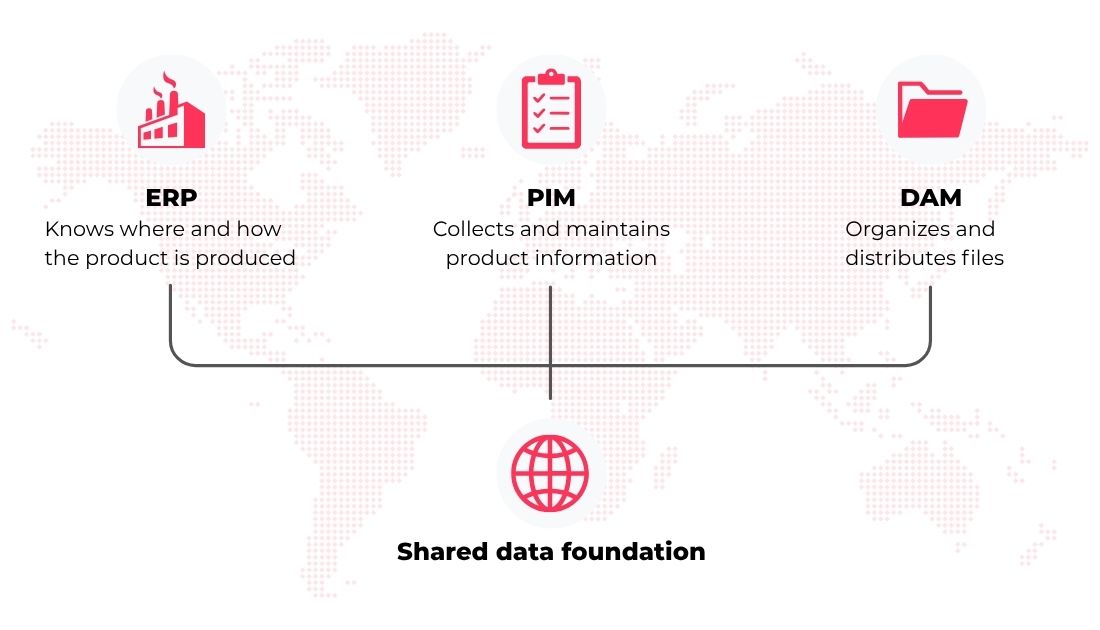
Automating this flow eliminates the need for employees to coordinate documents manually by email. Whether a customer meets with a sales agent in Southeast Asia or Europe, they access the same accurate product information.
This ability to maintain a single source of truth across languages and production sites is what separates companies that can scale from those held back by the volume of manual work required to increase sales.
The need for structured, traceable product data is becoming even more urgent with the arrival of the Digital Product Passport. The ability to document a product's origin, materials, environmental characteristics, safety, repairability, and recyclability is no longer simply a customer benefit. Inaccurate information and a lack of compliance can have serious consequences for relationships with customs authorities, customers, and distributors.
That is why PIM plays a central role for export companies seeking a standardized way to structure and distribute product data across the value chain.