Article Series

How to become an AI-ready manufacturing company

Part 5: AI Raises the Stakes for Data Quality

BY JAKOB HUUS ANDREASEN

In part 4, we explained how digital self-service makes exporters more scalable and better equipped to manage global growth and use AI.

But what does it take to implement AI across the organization? AI acts like a magnifying glass: it amplifies the value of accurate, structured data, but it also magnifies the consequences of incomplete and contradictory data.

Is AI a cure-all for the complex challenges of global trade?

Well, it could be. But export-driven manufacturers need to understand that AI is not a magic tool that can instantly streamline and take over critical tasks overnight.

Instead, AI acts like a magnifying glass. It dramatically increases the value of high-quality, structured data. But when data is unstructured and managed without a strategy or proper security controls, AI amplifies the existing data chaos.

When a customer or sales agent in an export market uses AI tools to find and compare products, the data must be accurate, up to date, and available in the relevant language. An AI assistant has no human intuition; it cannot determine whether a local manual is the latest version. If the data is fragmented and inconsistent, the AI solution will provide unreliable answers, potentially including information that should never be shown to an agent or end customer.

For example, it is not enough for an AI tool to find a price. It must also know whether that price applies to the specific customer, the relevant market, and the correct product variant. A fast answer is not necessarily an accurate one.

AI Requires Data Strategy and Leadership

We have already discussed the PIM system as the hub of the digital export business. Authoritative product data and a shared data model are prerequisites for any AI initiative. Do you have an architecture that can provide data to both your own AI solutions and the large language models your customers use?

AI readiness does not come from one large, unwieldy project. It starts with mapping your current data environment. That means answering questions such as:

  • Where is product data actually maintained today?

  • How many versions exist across subsidiaries and sales agents?

  • Where do the sales channels farthest from headquarters obtain their materials?

Asking the right questions brings you closer to a strategy. Where could an AI tool make the greatest difference for your business?

Start with a clearly defined area, such as ensuring complete, high-quality data for spare parts or one specific export market. Then establish the first building block for a solution in which data flows automatically and is machine-readable.

The foundation for AI is really just common sense applied systematically: Maintain one accurate source of data and move forward one step at a time.
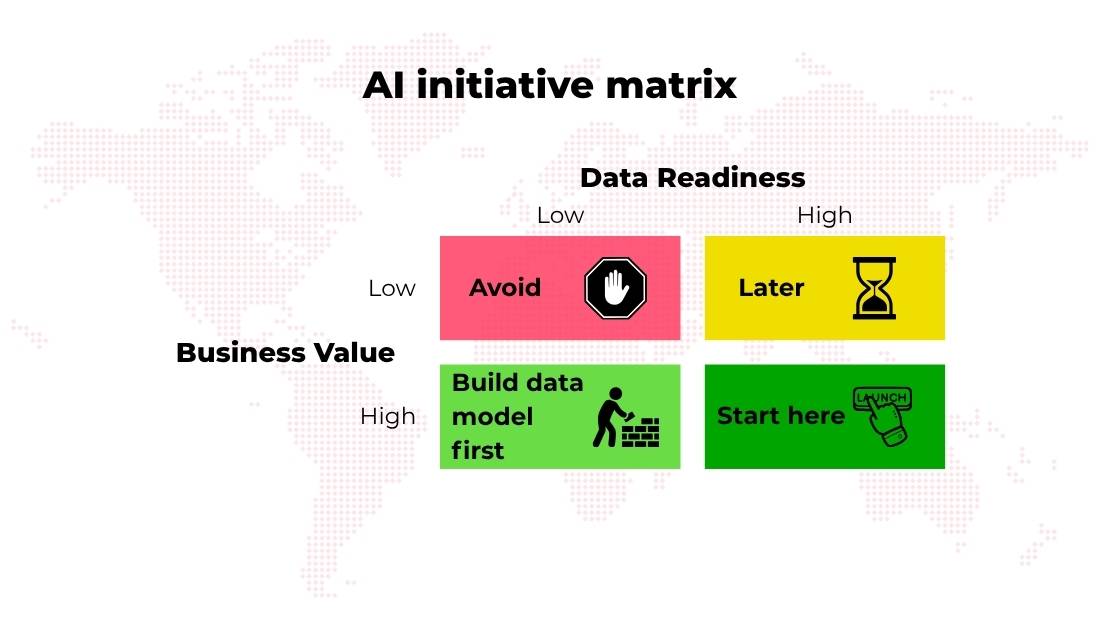

How to Choose Your First AI Initiative

AI initiatives should be evaluated based on both business value and data readiness. The best first use case offers high expected value and relies on data the company already controls.

  1. Choose a specific business process.

  2. Identify the data the process requires.

  3. Verify data quality, access, and security.

  4. Define what the AI may answer or do.

  5. Test whether the AI tool meets the specifications.

  6. Scale to the next use case.

Graphic of AI-readiness matrix, business value combined with data readiness

From Digital Foundation to AI

The first four articles focus on establishing the foundation: a shared data model, connected systems, digital sales channels, and automated processes. This work makes it possible to improve efficiency with AI on a solid foundation.

With a centralized architecture, a robust data model, and a clear data strategy, exporters are better equipped to break through the invisible ceiling on international growth. They are also better positioned to integrate AI into the business as needs and opportunities arise.

This is what prepares exporters to improve efficiency with AI-powered quoting processes and intelligent search tools. Over the longer term, it can also enable autonomous sales and purchasing processes in which digital assistants search, compare, configure, and initiate purchases within defined parameters.

The path to becoming an AI-ready export business does not begin with selecting an AI tool. It begins by identifying where fragmented data and manual workflows create the most friction, then solving one clearly defined business problem at a time.

Ready to see what our AI platform can do for you?

Book a live demo with your own business as the starting point.

Image of Jakob Huus Andreasen

Jakob Huus Andreasen

Director of Sales

Mobile: +45 23 25 26 12

Email: jha@alpha-solutions.com