Part 1: The Digital Ceiling for Export Companies
Many Danish manufacturers have a distinctive structure that has helped them become global market leaders in their niches. We often find that the vast majority of revenue comes from international markets, while the domestic market primarily serves as a showcase.
Their success typically rests on a division of responsibilities: The parent company in Denmark handles development, technology, and production, while global reach is secured through a tightly knit network of company-owned sales subsidiaries and independent agents. Yet behind the impressive export figures lies a digital reality that is often overlooked.
Digitization is typically addressed through internal process improvements or an online store—solutions designed for one market, one currency, and one customer journey. For a global manufacturer operating across multiple markets, that framework is rarely sufficient. These companies hit what might we call the "invisible ceiling": a point where global complexity grows faster than their processes can support.
More Sales Channels = Harder Data Management
The challenge starts with the company's structure. Sales typically take place through several channels at the same time:
Production and direct sales from Denmark
Manufacturing capacity in countries such as Poland or India
Sales through local subsidiaries in international markets
Sales through independent agents that often represent multiple suppliers.
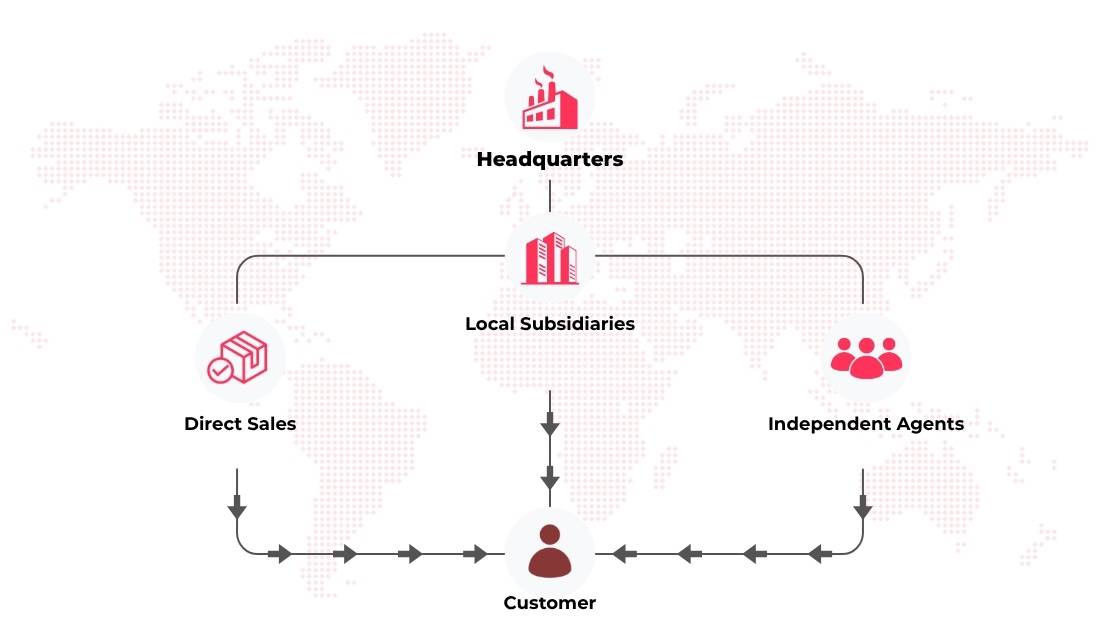
The structure is a strategic strength in itself because it provides a local presence. But it also creates digital challenges that a manufacturer operating only in Denmark would never face to the same extent.
One of the most critical business risks in this structure is that product data can easily end up existing in multiple fragmented versions across markets.
Imagine a price list that is updated at the parent company in Denmark while an agent in South Korea unknowingly continues to use last year's version because there is no central system that automatically distributes updates throughout the sales organization.
In practice, this affects more than price lists. Technical specifications, compliance documentation, product images—every data type that is not distributed centrally and automatically risks existing in multiple conflicting versions across sales subsidiaries and agents. It is only a matter of time before someone works with outdated information.
Manual Updates Are the Bottleneck to Growth
Without a single source of product data, every product launch or update becomes a massive coordination effort involving many people and just as many systems.
New specifications must be sent to subsidiaries, translated, forwarded to agents, and entered manually into local spreadsheets or systems—every time, at every step. The more markets and channels involved, the more cumbersome the process becomes. Eventually, the coordination effort grows faster than the organization can keep up.
Growth is constrained—not by decrease in demand, but by the company's internal ability to distribute data.
This raises a question that most export companies struggle to answer precisely:
Does every part of the sales organization have access to the same data, in its own language, updated in real time—and if not, where does the process break down?
AI Compounds the Problem; It Does Not Solve It
Addressing these issues becomes only more urgent as AI adoption grows. Chatbots, search tools and predictive AI are only as good as the data they rely on. If product data is scattered and inconsistent, the AI solution will inherit the same fragmentation—regardless of the quality of the manufacturing operation and technical core at the headquarters.
Building a centralized data foundation is therefore not merely an abstract prerequisite for AI solutions—it is the specific bottleneck that determines whether the investment pays off. International agents, who work far away from the company's systems, feel the consequences first.
In the next article, we look at how sales agents can be brought into the central data structure—giving them access to up-to-date prices, product data, and documentation without manual workarounds.